Building secure digital platforms without burnout
Security and speed do not have to compete if the architecture is planned around trust, clarity, and resilience.
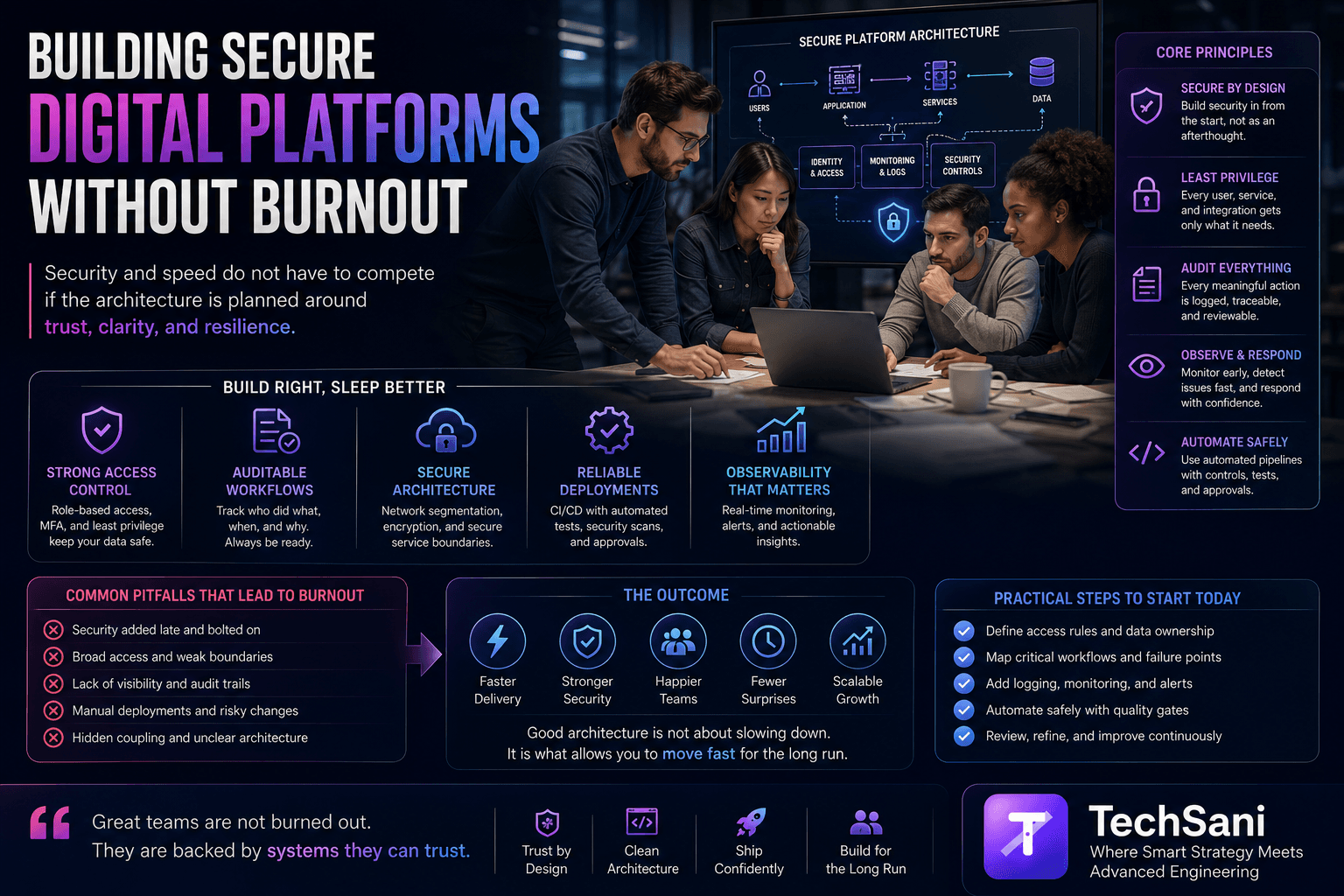
Many teams treat security as a late-stage concern, but that usually creates more pressure than necessary. Secure systems are easier to maintain when controls are built into the design from the beginning rather than patched in later.
It is a common story: a product ships fast, gains traction, and only then does the team start asking hard questions about access control, data handling, and audit trails. Retrofitting security into a system that was not designed for it is slow, expensive, and stressful, usually because the fixes touch code paths that were never built with those constraints in mind. Engineers end up racing against both the clock and the architecture at the same time.
A modern engineering approach balances delivery speed with reliability. That means clear access rules, auditable workflows, and thoughtful deployment practices that make the team confident during growth. None of this requires slowing down early-stage development. It requires deciding, upfront, who can access what, how changes get reviewed, and how the system behaves when something goes wrong, before those decisions become urgent.
One of the most sustainable practices is designing for least privilege from day one: every service, every user role, and every integration should have access to exactly what it needs and nothing more. This sounds like an obvious principle, but in practice it is one of the first things teams skip under deadline pressure, and one of the hardest things to retrofit once dozens of integrations depend on broad access.
Auditable workflows matter just as much as access control. When every meaningful action in a system leaves a trace, of who did what and when, debugging becomes faster, security incidents become easier to investigate, and compliance requirements become far less painful to meet. Building this in from the start is inexpensive. Adding it after the fact, across an already-complex system, is not.
Burnout on engineering teams often traces back to architecture, not effort. Systems that were not designed with clear boundaries tend to accumulate hidden coupling: a change in one area unexpectedly breaks something in another, and every deployment becomes a small act of faith. Over time, this erodes both the reliability of the product and the confidence of the team maintaining it.
The fix is not heroics. It is intentional architecture: clear service boundaries, predictable deployment pipelines, and monitoring that surfaces problems before customers notice them. A team that trusts its own systems can move faster, not slower, because they are not spending half their energy double-checking that nothing quietly broke.
Security and velocity are often framed as opposing forces, but that framing is misleading. The teams that ship quickly and safely over the long run are usually the ones that invested early in access control, observability, and clean deployment practices, not the ones that skipped those steps to save a few weeks upfront. The cost of skipping them does not disappear; it just moves further down the timeline and gets larger.
At TechSani, we design platforms with security and maintainability treated as first-class requirements, not afterthoughts. The result is software that a team can grow into confidently, without the constant background anxiety of an architecture that was never built to last. If your current system feels fragile under growth, that fragility is almost always an architectural signal worth listening to.