Choosing the right AI strategy for business
The real advantage does not come from chasing every new model release; it comes from building an adaptable AI foundation for your business.
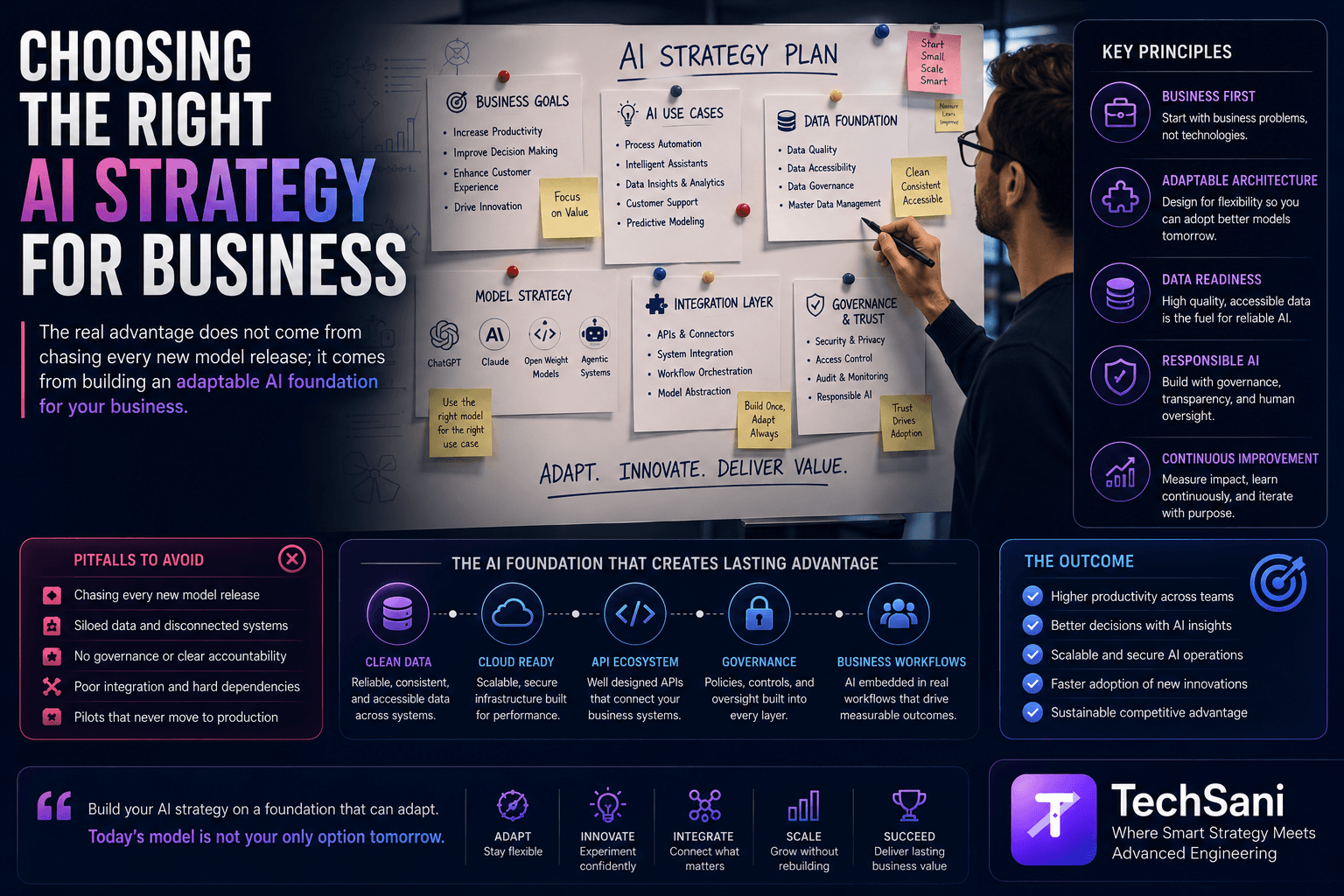
Choosing the right AI model is no longer the biggest challenge. Choosing the right AI strategy is. Businesses today are flooded with new options, from ChatGPT and Claude to newer open-weight and agentic systems, and the pressure to pick the latest tool can distract from the real objective.
Every few months brings a new headline model, a new benchmark, a new claim of a step change in capability. It is easy for leadership teams to feel like they are constantly one release behind, and to treat AI adoption as a race to plug in whichever model is newest. That instinct is understandable, but it usually leads to fragmented pilots that never make it past a demo, because the underlying business has not built the foundation to actually use the model at scale.
The most important decision is not whether to choose one model over another. It is whether your organization has the data, governance, integration layers, and architecture needed to use AI responsibly and at scale. A strong model can accelerate productivity, but it cannot create long-term value without secure workflows and reliable infrastructure behind it. A brilliant model connected to messy, inconsistent data will produce brilliant-sounding but unreliable output.
At TechSani, we see enterprise AI as an ecosystem decision. The right approach combines clean data, well-designed APIs, cloud readiness, governance, and business-focused workflows. That is what gives organizations flexibility when new models emerge and ensures they can adapt without rebuilding everything from scratch. When the integration layer is built well, swapping in a newer or better model becomes a configuration change, not a six-month re-engineering project.
Governance is often the most neglected part of an AI strategy, and also the part that determines whether a pilot survives contact with legal, security, and compliance teams. Questions worth answering early include: what data is the model allowed to see, where does that data go, who is accountable when the model gets something wrong, and how are outputs reviewed before they reach a customer or a decision-maker. Answering these questions after deployment is far more disruptive than answering them during design.
Data readiness deserves equal attention. Many organizations discover, partway through an AI initiative, that their data is scattered across systems that were never meant to talk to each other, inconsistently labeled, or simply not accessible through a clean API. No model, however capable, can compensate for data that is fragmented or untrustworthy. Investing in data quality and accessibility is frequently the highest-leverage step in any serious AI strategy.
It also helps to separate AI initiatives into two categories: internal productivity tools, where the risk of an imperfect output is low and the speed of iteration matters most, and customer-facing or decision-critical systems, where accuracy, auditability, and human oversight matter far more than speed. Treating both categories with the same level of caution either slows down harmless experimentation or exposes the business to unnecessary risk.
The future belongs to companies that build for adaptability rather than dependency. In practical terms, that means creating a platform that can support multiple models, connect to internal systems, and align AI usage with clear business goals. The result is not just faster experimentation; it is durable competitive advantage, because the organization is not locked into a single vendor's roadmap or pricing decisions.
A useful test for any AI initiative is to ask what happens if the specific model being used today is deprecated or replaced next year. If the answer involves rebuilding significant parts of the system, the architecture was built around a model rather than around the business. If the answer is a straightforward swap, the foundation was built correctly. At TechSani, that second outcome is the standard we design toward for every AI engagement.