Why modern businesses need custom software now
Off-the-shelf tools can start strong, but growth usually exposes process gaps that only tailored software can close.
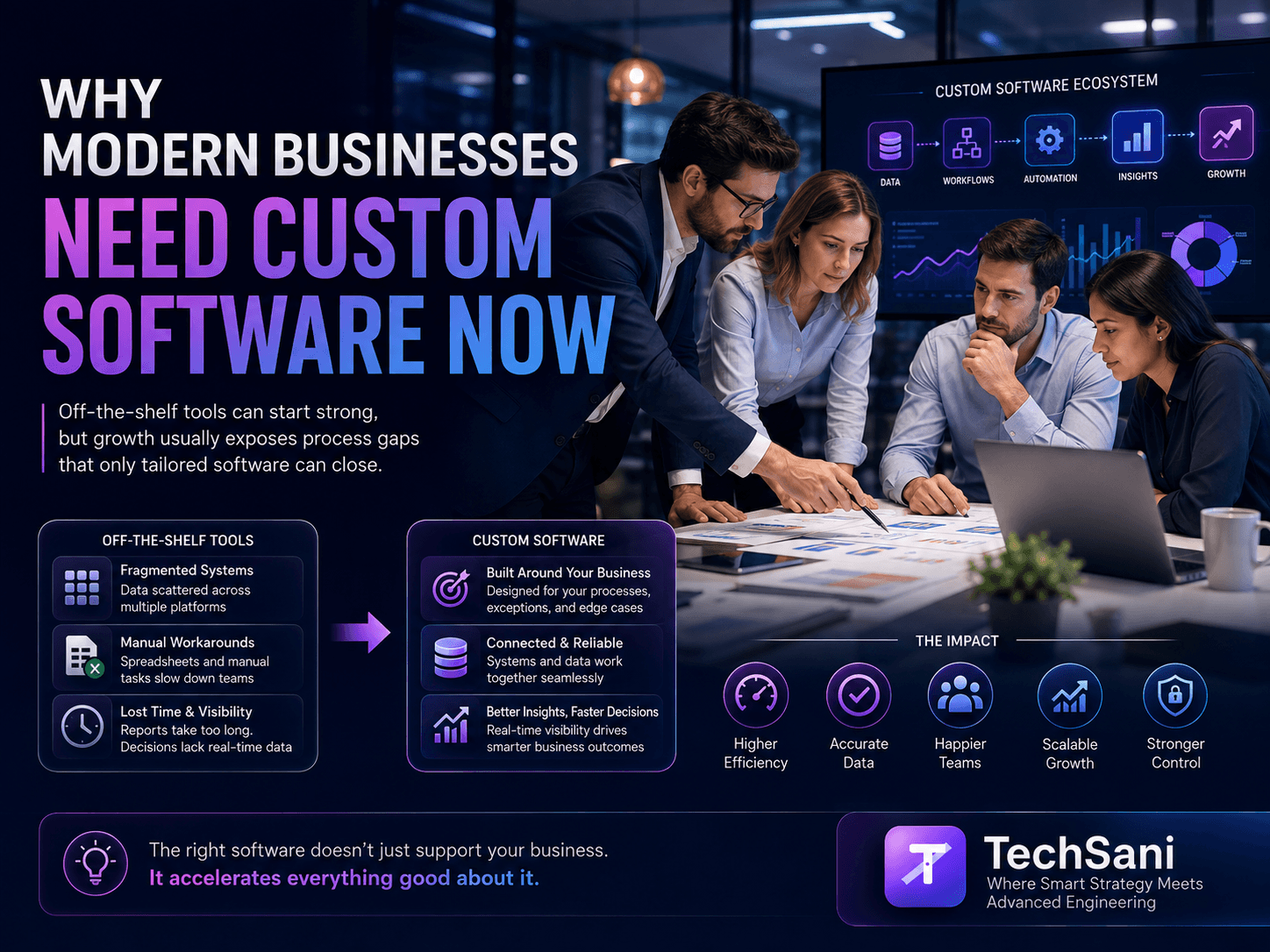
When a business grows, the tools that once felt efficient quickly become the reason work slows down. Teams begin relying on spreadsheets, fragmented platforms, and manual handoffs because the existing stack was never designed for the real rhythm of the company.
This is a familiar pattern. A company adopts a handful of off-the-shelf tools early on because they are fast to set up and cheap to try. For a while, that works fine. But as headcount grows, as new departments form, and as customer expectations rise, those same tools start to strain. Data lives in three different places. Updating one record means updating it manually in two others. Reports take a full day to assemble because nothing talks to anything else.
That is where custom software becomes valuable. It does not just automate a workflow; it removes friction at the points that matter most. In many cases, the problem is not a lack of effort from the team, but a lack of alignment between the software and how the business actually operates. Off-the-shelf platforms are built for the average company in a category, not for your specific processes, exceptions, and edge cases.
A well-built system can standardize operations, give leadership better visibility, and create a foundation for faster decisions. The goal is not to add more tools; it is to make the business simpler to run. When software is designed around the actual shape of your operations, employees stop working around the system and start working with it.
One of the clearest signals that a business has outgrown its current tooling is the rise of manual workarounds. If your team maintains a shadow spreadsheet to track what the main system cannot, or if someone has to manually reconcile numbers between two platforms every week, that is custom software territory. These workarounds feel small individually, but they compound into real cost: slower onboarding, inconsistent data, and decisions made on outdated information.
Custom software also pays off in ways that are easy to underestimate at the start. Because the system is built around your actual data model, integrations with other tools become far more reliable. Because the interface reflects how your team actually thinks about the work, training new hires takes less time. And because you control the roadmap, you can prioritize the features that matter to your business instead of waiting for a vendor's release cycle.
There is a common misconception that custom development is only for large enterprises with big budgets. In practice, the right scope of custom software can be modest: a single internal tool that replaces three disconnected spreadsheets, or a lightweight API layer that connects your CRM to your billing system. The goal is not to rebuild everything at once, but to identify the one or two points of friction that are costing the most time and solve those first.
A good starting point is to map where your team spends time on tasks that feel repetitive, manual, or error-prone. Ask which of those tasks exist purely because two systems do not talk to each other, or because a process was designed around a tool's limitations rather than your business needs. Those are usually the highest-leverage places to invest in custom software.
At TechSani, we approach custom software the same way: start with the operational bottleneck, not the technology. A system that removes friction at the right point in the business will pay for itself many times over, while a system built for its own sake rarely does. If growth is exposing gaps that your current tools cannot close, that is usually the clearest sign it is time to talk to an engineering partner.