How AI automation reduces operational overhead
Small automation wins can create measurable savings when they remove repetitive work across teams and systems.
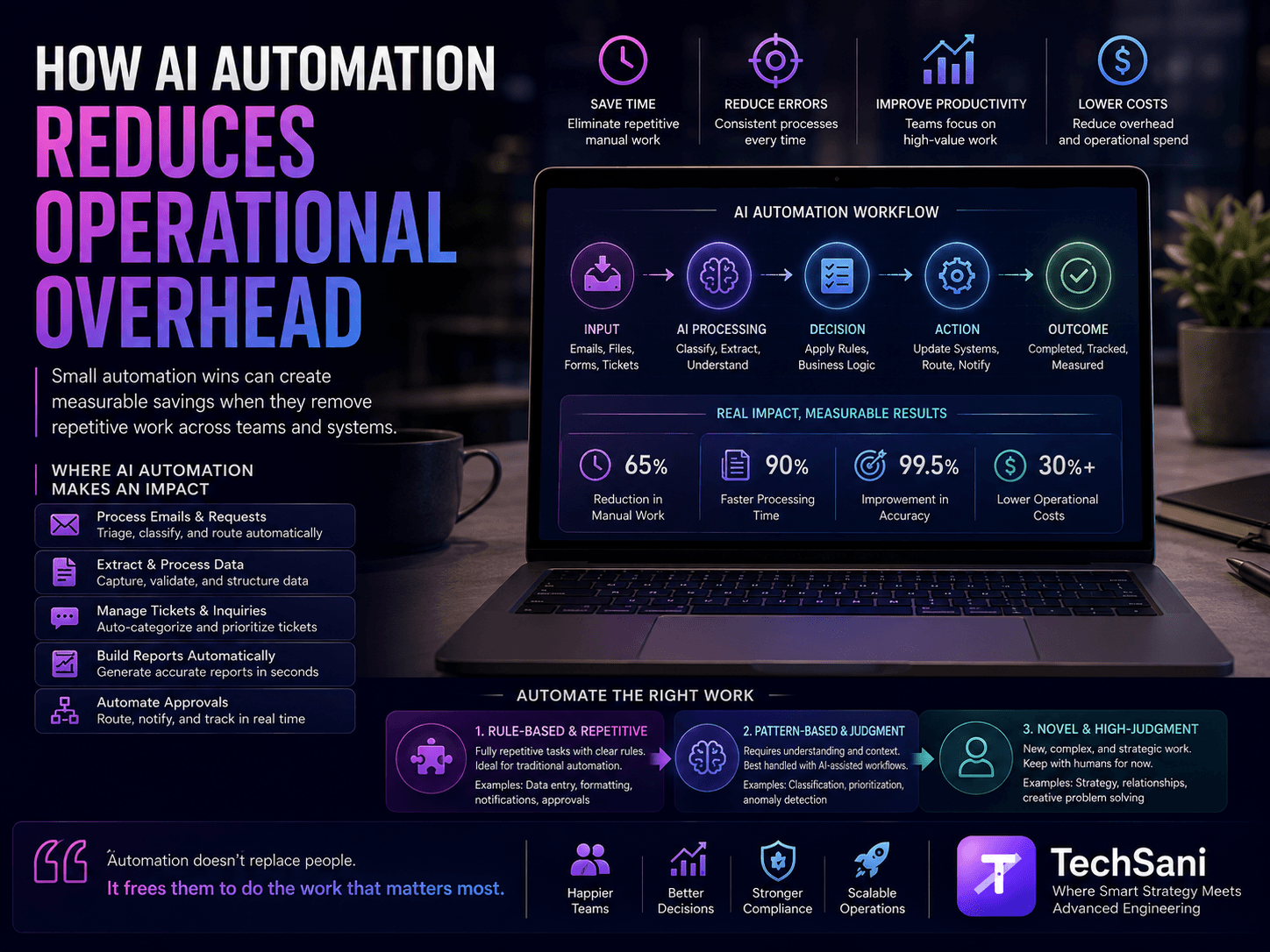
Operations teams often spend valuable hours on tasks that are repetitive, predictable, and easy to standardize. These are perfect candidates for automation because the long-term benefit is not just speed, but consistency.
Think about the last time someone on your team manually copied data from an email into a spreadsheet, or reviewed a queue of support tickets just to sort them into categories a computer could sort in milliseconds. These moments rarely feel urgent enough to fix on their own, but added up across a week, a quarter, or a year, they represent a significant and recurring cost in time and attention.
AI-assisted workflows can help teams triage requests, classify incoming data, and surface actionable insights without waiting on manual review. When paired with well-designed business logic, the result is a faster operating rhythm and fewer errors. Unlike traditional rule-based automation, AI-assisted systems can handle the ambiguity that real-world operations always contain: messy input, inconsistent formatting, and edge cases that would break a rigid script.
The most effective automation projects begin with a clear bottleneck. Once the repetitive step is identified, the next step is to remove the delay and make the process visible to the people who need it. Automation that runs silently in the background, with no visibility into what it decided or why, tends to erode trust over time. Good automation surfaces its reasoning and gives humans an easy way to review and override when needed.
A useful way to evaluate automation opportunities is to separate tasks into three buckets: fully repetitive and rule-based, pattern-based but requiring judgment, and genuinely novel. The first bucket is ideal for traditional automation. The second is where AI-assisted workflows add the most value, because they can recognize patterns from historical data without needing every rule spelled out explicitly. The third bucket should generally stay with humans, at least for now.
Operational overhead does not only come from big, obvious inefficiencies. It often accumulates from dozens of small frictions: an approval that has to be manually routed, a report that has to be manually compiled every Monday, a customer inquiry that has to be manually categorized before it reaches the right team. None of these individually justify a large engineering project, but together they are exactly the kind of work AI automation is built for.
There is also a cultural dimension to automation projects that is easy to overlook. Teams are more likely to trust and adopt automation when they understand what it is doing and can see the impact directly, such as fewer tickets sitting in a queue or faster turnaround on requests. Involving the operations team early, rather than treating automation as something done to them, consistently produces better outcomes and faster adoption.
The financial case for automation compounds over time. A workflow that saves even thirty minutes per person per day translates into meaningful capacity across a growing team, capacity that can be redirected toward higher-value work instead of repetitive tasks. That is the real return on AI automation: not replacing people, but freeing them to focus on the parts of the job that actually require judgment, creativity, and relationships.
At TechSani, we start every automation engagement by mapping the operational bottleneck before touching any technology. The goal is never automation for its own sake, but a measurable reduction in the manual work that slows a team down. If your operations team is spending more time managing tools than doing the work those tools are meant to support, that is usually the clearest signal that it is time to automate.