Managed IT Services vs. IT Consulting: What's the difference?
These two disciplines often overlap, but the right choice depends on whether your business needs strategic guidance or operational consistency.
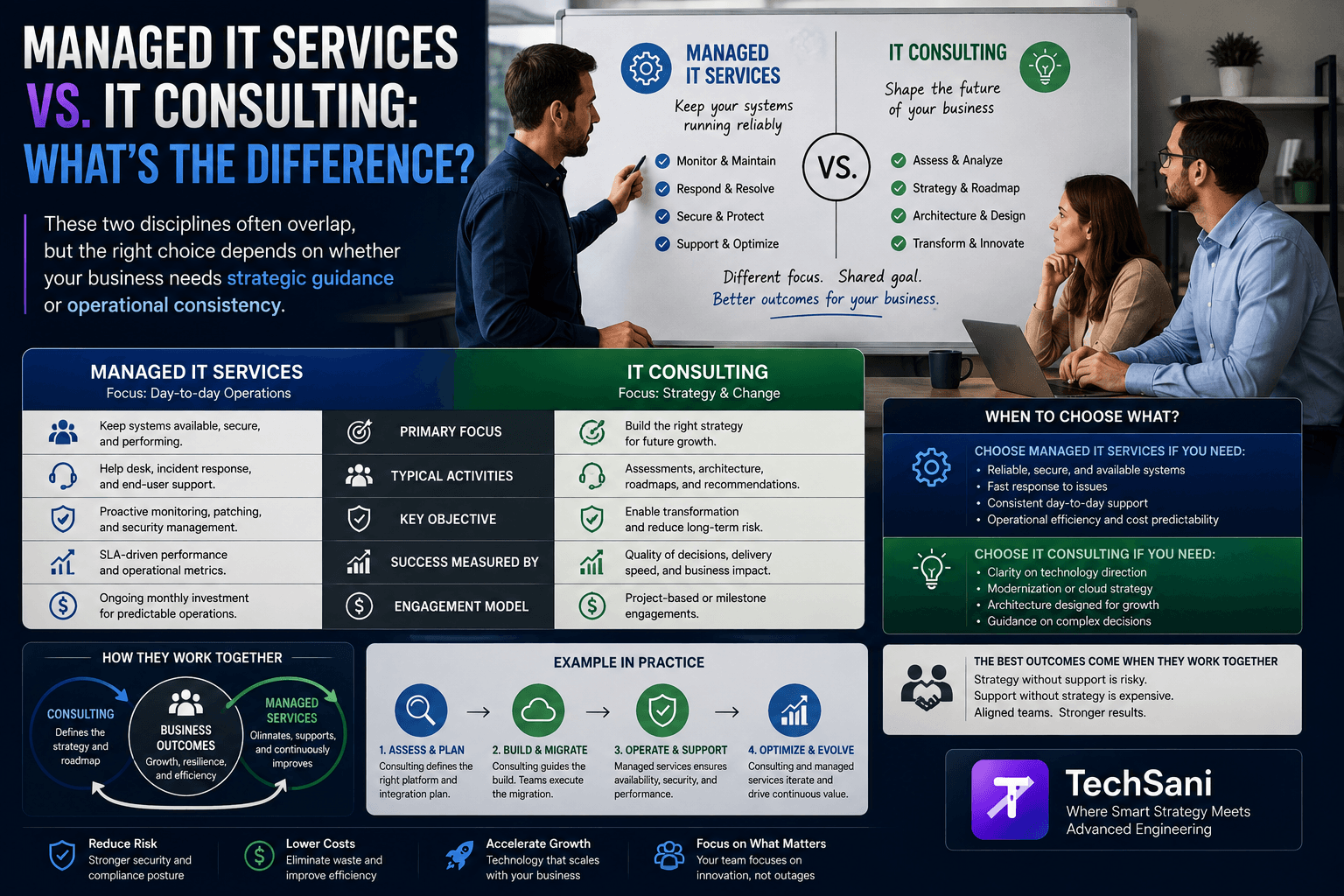
Managed IT services and IT consulting are often spoken about as if they are the same thing. In reality, they serve different roles in a business's technology ecosystem. One is focused on keeping existing systems running reliably, the other is focused on shaping what those systems should become.
Managed IT services are the team that takes responsibility for your day-to-day operations: monitoring infrastructure, responding to incidents, patching security issues, and handling routine support. The goal is stability, predictability, and a fast resolution when things go wrong.
In contrast, IT consulting focuses on change and strategy. It helps organisations decide which systems to build or modernize, how to align technology with business goals, and which architectures will support growth without creating new risk. Consulting is about the next stage of the roadmap, not the current operational health.
That said, the two are not mutually exclusive. The best outcomes come when the managed services team and the consulting team share a common understanding of the architecture, responsibilities, and constraints. If they operate in separate silos, the organisation can end up with a strong strategy that is hard to maintain, or a stable environment that is unable to evolve.
A helpful way to distinguish them is to ask: who is responsible for the system today, and who is responsible for the system tomorrow? Managed services answer the first question. IT consulting answers the second. Both are necessary, especially for enterprise organisations where downtime is expensive and change is constant.
Another important difference is how the work is measured. Managed IT services are often measured by response time, uptime, and ticket resolution. IT consulting is measured by the quality of decisions, the speed of delivery, and the degree to which the chosen path reduces risk and waste.
For businesses in Kent or the wider UK market, the choice is rarely between one or the other. It is usually about how to make them work together. A local IT consulting company can help define the strategy, while a managed support provider can keep the chosen systems running smoothly.
An example from real practice: a business may decide it needs a new cloud-based order management platform. The consulting work determines the right architecture, integration points, and rollout plan. The managed services team then ensures that the new platform remains available, secure, and performant after launch.
When evaluating a partner, ask whether they offer both perspectives. If they only talk about strategy, you may find the implementation gap becomes your problem. If they only talk about support, you may miss the chance to make the next architecture change with confidence.
This is why the phrase 'IT services and consulting' appears together so often. For growing businesses, the real benefit comes from a partner that can help with both strategic decisions and the ongoing service model that keeps the business moving.
At TechSani, we work with clients to make that handoff explicit. We define the architecture in a way that support teams can maintain, and we design support models that do not treat the environment as a black box. That alignment is what makes managed IT services and IT consulting genuinely complementary.
If you are choosing between them, the right path is usually not one or the other. The right path is to make sure your strategy is grounded in what can be supported, and your support model is aligned with the strategy. That is the difference between a technology vendor and an enterprise IT partner.