What does an IT consulting company actually do?
Real IT consulting is not just a report. It's a sustained partnership that stitches strategy, architecture, and operations together.
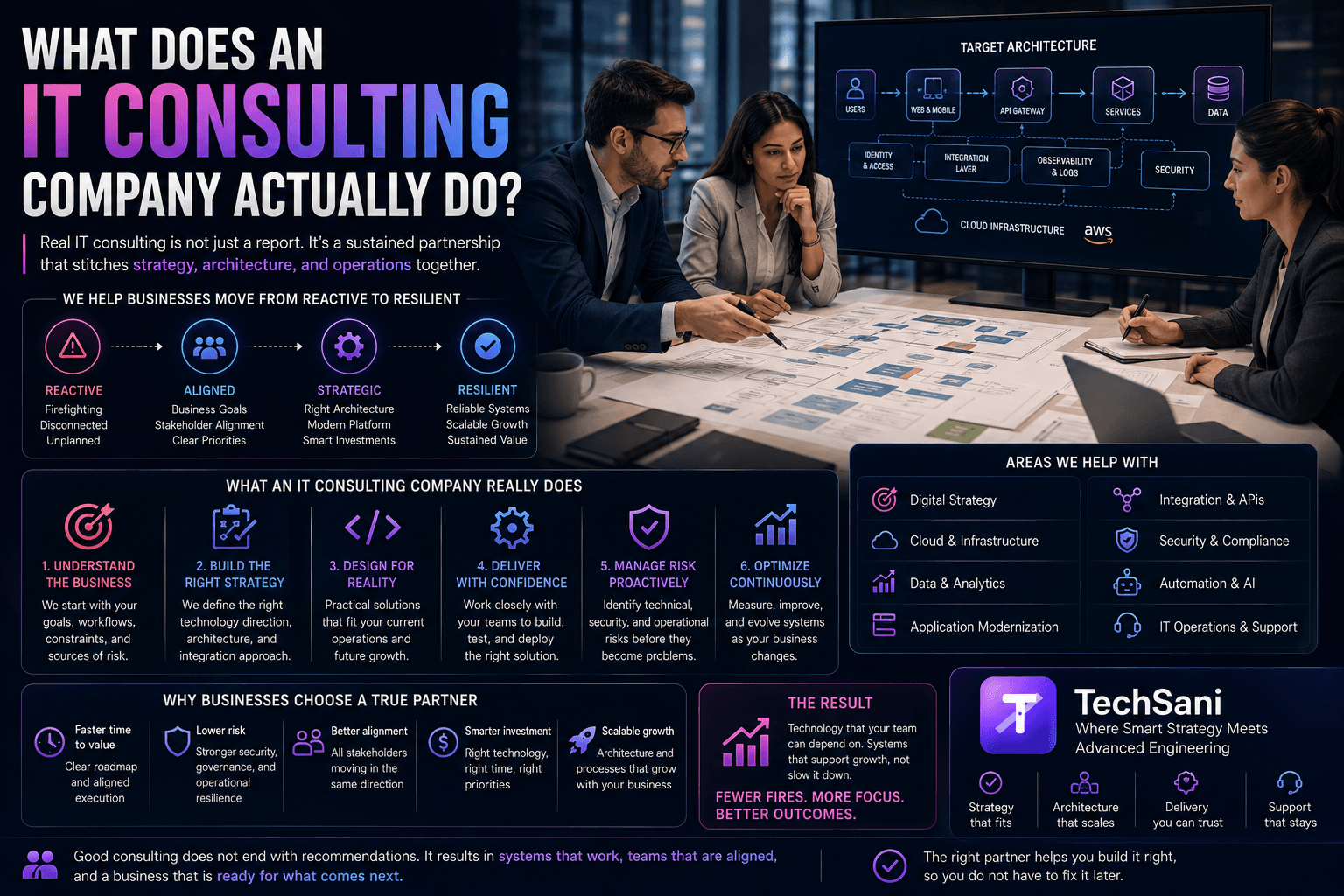
IT consulting is often presented as a one-off assessment: a brief audit, a slide deck, and a list of recommendations. The companies that get the most value do not treat it that way. They use IT consulting as a long-term partnership that helps the business move from reactive firefighting to planned, resilient execution.
At its best, an IT consulting company helps leaders answer two questions clearly: what technology will support our growth, and how will we make sure it keeps supporting us as the business changes? The deliverable is not a report that sits on a shelf. It is a practical set of decisions, aligned to your current operations, that the engineering team can execute and maintain.
That starts with understanding what the business is actually trying to do. Too many technical engagements begin with the wrong benchmark: the internal preferences of the current team, the latest trend, or the capabilities of a vendor’s existing stack. A strong IT consulting company starts with the workflows, constraints, and sources of risk that matter to the business.
From there, the consultant maps the most effective path forward. That may mean modernizing a legacy platform, moving core systems to the cloud, or defining API contracts that let the business scale without patching brittle integrations. Whatever the direction, the work is grounded in the reality of how the organisation operates today.
A second distinction is the balance between strategy and delivery. Some consultants stop at strategy and hand a plan to a delivery team. Real value comes when the same people who understand the architecture also help make it real. That is why companies that need enterprise-level change choose partners who can both design and build, or at least work very closely with the build team.
Third, an IT consulting company should make the risks visible before they become problems. That means not only identifying technical debt and security gaps, but also evaluating operational risk: what happens if a system is unavailable, if a vendor changes terms, or if internal priorities shift. Good consulting makes those outcomes part of the conversation, not a hidden footnote.
Fourth, the role is not purely technical. It often includes facilitation, governance, and stakeholder alignment. When the consultant can explain trade-offs to finance, operations, and leadership in language they trust, the project moves faster and with fewer surprises. That is one reason the phrase 'IT consulting company' can be misleading: the work is as much about organisational clarity as it is about code.
Fifth, the relationship should have clear checkpoints. An effective IT consulting engagement includes regular reviews, measurable milestones, and a shared definition of success. That prevents the work from drifting into vague recommendations and ensures the team can adjust when the business reality changes.
For companies looking at IT consulting, the right question is not simply 'what technology should we use?' It is 'how will this technology support the business in year one, year two, and beyond?' The answer should be a roadmap, not a one-time diagnostic.
If your current systems feel fragile, slow, or disconnected, an IT consulting company can help make the path forward visible. It is not about chasing the latest tool. It is about choosing the architecture, integration approach, and operating model that let your people depend on technology rather than make it an extra burden.
At TechSani, that means connecting our consulting work to the delivery teams and support rotations that keep systems live. We do not just recommend a target state. We help businesses get there with a plan that is feasible, measurable, and resilient.
The simplest way to tell whether a consulting engagement is worth it is to ask whether it will reduce the number of times your team needs to fix the same issue. If the answer is yes, it is probably doing the right kind of work. If it only produces another document, it is probably not the kind of IT consulting company your team needs.